
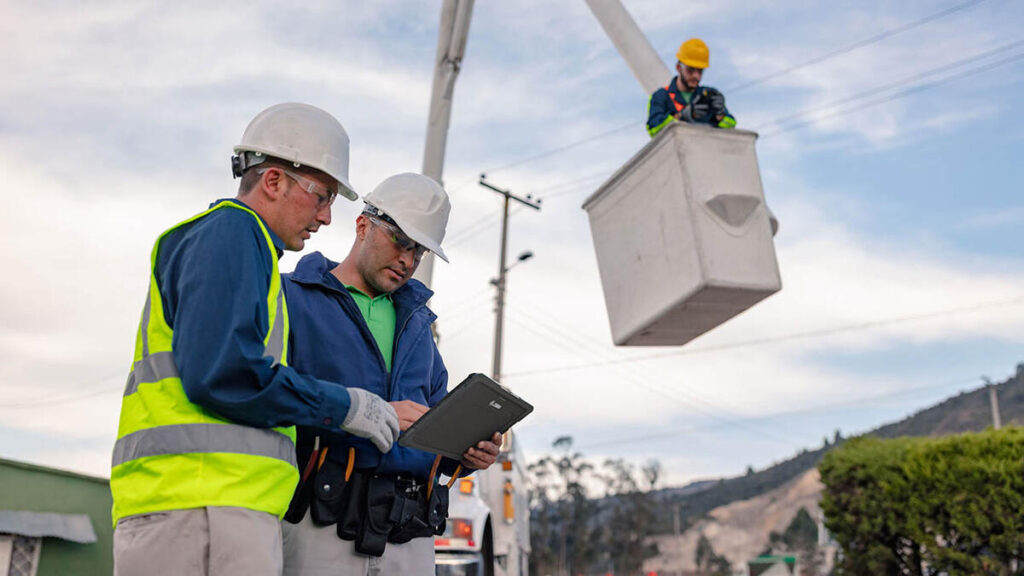
With new 5G rugged tablets such as the Zebra ET85 hitting the market, those in the public safety, manufacturing and field service sectors are curious if there will be an immediate benefit. Enterprise mobility expert Bruce Willins weighs in.
5G adoption continues to accelerate, with some analysts predicting worldwide 5G smartphone adoption to account for 43% of the global market by the end of 2021. This may have you asking: “Is now the right time to buy 5G devices for my workers? And, if not now, when?”
So, we invited Zebra technology solutions engineering fellow and “what’s next in wireless” guru Bruce Willins back to talk this through a bit more:
Your Edge Blog Team: It’s been five months to the day since we last spoke about the state of 5G. At that time, you said that “it’s going to take a long time for full 5G capabilities to become pervasive.” By some measures, five months is considered a long time. So, can you help put in perspective where we are today in terms of getting the full value of 5G? Do we need to temper expectations?
Bruce: The scope of “5G” is quite broad, so much more than 4G “plus 1.” It’s also a moving target. As infrastructure shifts from Non-Standalone (NSA) to Standalone (SA), new capabilities are added in subsequent releases (i.e., URLL), and new business models evolve, leveraging features like network slicing. Recall also, the many use cases of 5G, ranging from Fixed Wireless Access (FWA) and mobile handsets to autonomous sensors and automated guided vehicles (AGVs). So, the truth is that 5G will coexist with 4G LTE and Wi-Fi for the foreseeable future. It’s not a replacement per se. At least not in the near term.
In the enterprise market, 5G is tracking the path we expected. Customers are buying a long service life device in anticipation of future needs, and we’re seeing specialized use cases like industrial automation where 5G is displacing hard-wired ethernet in manufacturing facilities or being used to connect high-def cameras for process monitoring/quality inspection.
Your Edge Blog Team: We’re starting to see more 5G devices come to market and, as you know, Zebra just introduced its first 5G device today: the ET85 rugged 2-in-1 Windows® tablet. Some people might be wondering why device manufacturers are moving so fast to rollout 5G capabilities if the backend/network capabilities and need aren’t there yet. Can you explain the strategy there?
Bruce: You’re right, the ET85 has a 5G connectivity option. But I think that’s the key point to make here: 5G is an option. If you have assessed the specific use case and work environment for the tablet and confirm you need to connect to 5G networks, then you’ll be covered.
Not everyone needs 5G capabilities now, and to your point, as a nascent technology, 5G infrastructure (NSA->SA) and handsets (3GPP Release 15 ->16, 17…) will continue to evolve. At the same time, 4G connectivity will persist for years to come.
So, at Zebra, we’re thinking about which organizations really need 5G capabilities, along with several other more advanced rugged mobile computing capabilities, to achieve some of their near-term operational objectives. From there, we’re developing mobility solutions such as the ET85 that offers well-rounded support. If they need 5G, they know there’s a rugged tablet that fits the bill. If they don’t need 5G, they can choose a 4G ET85 configuration and still get the other advanced features and capabilities they need to sustain their operations for several years. They don’t have to compromise just because they aren’t opting into 5G yet.
Your Edge Blog Team: Can you give us a scenario where a 5G tablet might be needed sooner rather than later?
Bruce: Think applications that might have a high density of users running high throughput, real-time applications. Certainly, incident response comes immediately to mind. Law enforcement agencies, fire departments, first responders, and others in the public sector may benefit from 5G if they want to expand their live video streaming capabilities for situational awareness. If an officer, firefighter or inspector is going into a building or trying to keep dispatch appraised of what’s happening at a scene, they might keep that tablet camera on to give others a big picture view. Or utility crews in the field might need to tap into a remote expert for assistance. If they don’t have wearable cameras, such as head-mounted displays, they could use the tablet’s integrated camera to simultaneously stream video of the transformer or other piece of equipment to that virtual specialist while reviewing manuals or diagrams on the tablet screen.
Your Edge Blog Team: It sounds like those who really need video-based collaboration capabilities should strongly consider a move to 5G devices, then?
Bruce: It’s definitely worth a conversation. If you are talking a large number of power users in a small area, then you may need 5G millimeter wave (mmWave) coverage and devices. If you are talking a relatively limited number of users streaming low-definition video, then 4G may be adequate.
Your Edge Blog Team: The examples you just shared primarily speak to field-based use cases. Does that mean that 5G coverage is expected to extend into remote or rural areas?
Bruce: It’s important to qualify “5G coverage.” More specifically, are you talking low-band, mid-band, or high-band coverage? Generally speaking, lower frequency bands provide more robust coverage, but lack the high throughputs available in high band, mmWave. Thus, expect initial rural 5G coverage to be relegated to low-band solutions, while densely populated areas may have (still relatively limited) mmWave coverage. Furthermore, Dynamic Spectrum Sharing (DSS) is increasing the 5G coverage map, because DSS 5G devices can operate over 4G spectrum infrastructure.
Coverage may also vary on whether we are talking public or private 5G networks. Take, for example, an enterprise customer with a campus in a rural area. There may not be a compelling business case for carriers to extend 5G coverage to this area. However, as a private network, the enterprise may deploy a higher capacity 5G infrastructure.
Your Edge Blog Team: Is demand for 5G building in more industrial environments as well, such as manufacturing or even warehousing?
Bruce: We’re seeing the use of autonomous mobile robots (AMR), collaborative robots (cobots), digital twins, larger sensor arrays, machine vision and other advanced technologies grow in various production, logistics and fulfillment settings. All of these require a certain level of wireless bandwidth, link reliability, and low latency.
Though these are not tablet applications, a 2-in-1 rugged tablet is very valuable to an aircraft factory worker who moves between an office or meeting room environment and a hangar during the engineering, production, and inspection phases.
Your Edge Blog Team: So, the takeaway is that if you do need 5G now or in the near future and you have confirmed true 5G network connectivity is available in the areas where they’ll be working, then it’s worth looking at the total benefits of a 5G device.
Bruce: If you have an immediate use case for 5G, then you are covered. If you’re not sure what’s coming (i.e., augmented reality) and want to extend the life of the device you’re purchasing today, then you are covered. Alternatively, if you don’t foresee the need for 5G features and/or lack 5G coverage, then you can stay on 4G without compromising on other features or capabilities. We’ve worked hard to provide different ET85 enterprise-grade 2-in-1 rugged tablet configurations to support a large number of customer use cases.
Your Edge Blog Team: What else should organizations keep in mind when making the decision about whether to equip workers with 5G devices this year or even in early 2022?
Bruce:
5G brings with it a broad array of features and opportunities but the technology may need some time to catch up to the marketing hype. As the saying goes, “mileage may vary.” Not everyone will need – or even benefit from – 5G capabilities for a while. Understand the nature of the 5G features, evaluate the utility of them relative to your applications, and be sure they will be available in your region, in your timeframe. As always, ask more technical questions – leverage solution providers like Zebra. Rest assured that we’ll continue to develop and test 5G solutions, monitor 5G standards development, and work with 5G silicon vendors to ensure your 5G needs are covered.
Source: https://www.zebra.com/
