
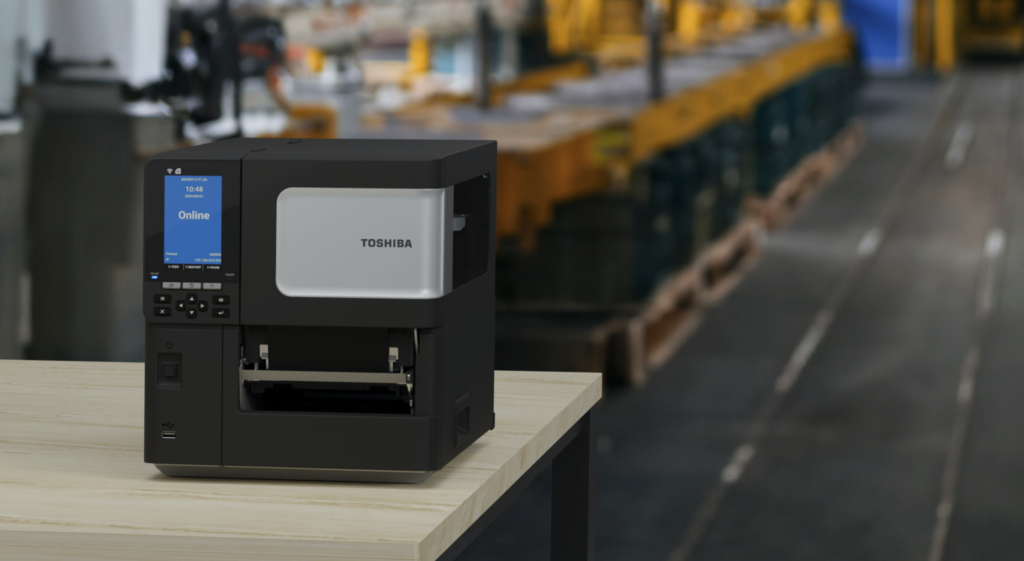
When businesses need reliable, high-volume label printing, an industrial label printer is designed to deliver the durability, speed and consistency required for demanding working environments. From manufacturing and warehousing to logistics and retail, industrial label printers help businesses produce clear, accurate labels while reducing downtime and improving operational efficiency.
What Is an Industrial Label Printer?
An industrial label printer is a heavy-duty printing device designed for continuous or high-volume label production. Unlike standard desktop label printers, industrial models are built to operate in demanding environments and are often designed for long print runs, harsh conditions and 24/7 workloads.
Industrial label printers can produce a wide variety of labels, including:
- Barcode labels
- Product identification labels
- Shipping and logistics labels
- Asset labels
- Inventory labels
- Compliance and safety labels
- Warehouse location labels
- Manufacturing labels
- Chemical and hazardous material labels
For businesses that rely on accurate identification and tracking, choosing the right industrial label printer can make a significant difference to productivity.
Why Choose an Industrial Label Printer?
1. Built for Demanding Environments
Industrial label printers are engineered for use in warehouses, factories, distribution centres and other challenging environments. Their robust construction helps them withstand dust, vibration, temperature changes and frequent use.
This makes an industrial printer a dependable choice for businesses where printer downtime can interrupt operations.
2. High-Speed Label Printing
Large warehouses and manufacturing facilities may need to print thousands of labels every day. An industrial label printer is designed to handle high-volume workloads while maintaining consistent print quality.
Fast printing speeds can help businesses:
- Reduce waiting times
- Improve warehouse productivity
- Process shipments faster
- Keep production lines moving
- Reduce printing bottlenecks
3. Excellent Barcode Print Quality
Accurate barcode printing is essential for inventory management, shipping and tracking. Industrial label printers provide precise, high-quality printing to ensure barcodes can be scanned reliably.
Depending on the model, businesses can print 1D and 2D barcodes, text, logos, product information and other variable data.
4. Thermal Transfer and Direct Thermal Printing
Many industrial label printers support thermal transfer and/or direct thermal printing.
Thermal transfer printing uses a ribbon to transfer ink onto the label material. It is suitable for applications requiring durable labels that can withstand exposure to abrasion, moisture, chemicals or temperature changes.
Direct thermal printing produces an image directly onto heat-sensitive media without requiring a ribbon. It is commonly used for shipping labels, receipts, temporary identification labels and other short-term applications.
Choosing between these technologies depends on your label material, application and required durability.
Common Applications for Industrial Label Printers
An industrial label printer can be used across a wide range of industries.
Manufacturing
Manufacturers use industrial printers for product identification, work-in-progress tracking, component labels, compliance labels and packaging.
Warehousing
Warehouse teams can use industrial label printers to create inventory labels, shelf labels, pallet labels, location labels and barcode labels.
Logistics and Shipping
In logistics, accurate labelling is critical. Industrial printers can produce shipping labels, parcel labels and tracking barcodes quickly and consistently.
Retail
Retailers can use industrial printing solutions for product labels, stock identification, pricing labels and inventory management.
Healthcare
Healthcare organisations may use specialised labels for specimen identification, asset tracking, medication management and other applications where accurate identification is essential.
Key Features to Look for in an Industrial Label Printer
When choosing an industrial label printer, consider the following features.
Print Resolution
Print resolution is usually measured in DPI (dots per inch). Common options include 203 dpi, 300 dpi and 600 dpi.
Higher resolutions can be particularly useful when printing small text, detailed graphics or very small barcodes.
Print Speed
If your business prints large quantities of labels, print speed is an important consideration. Look for a printer that can handle your required volume without creating workflow bottlenecks.
Media Capacity
Industrial printers are often designed to accommodate larger rolls of label media, reducing the need for frequent media changes.
Connectivity
Depending on your environment, you may need connectivity options such as:
- Ethernet
- USB
- Wi-Fi
- Bluetooth
- Serial connectivity
Network connectivity can make it easier to integrate the printer into existing warehouse, manufacturing or business systems.
Durability
A good industrial printer should be able to withstand the conditions in which it will be used. Consider factors such as dust, moisture, temperature, vibration and continuous operation.
Software and Integration
Modern industrial label printers can integrate with warehouse management systems, enterprise resource planning systems, inventory software and other business applications.
Easy integration can help automate label production and reduce manual data entry.
How to Choose the Right Industrial Label Printer
Before purchasing, consider your specific requirements.
1. What will you print?
Determine whether you need shipping labels, product labels, barcodes, asset tags or specialised labels.
2. How many labels do you print?
Estimate your daily and monthly label volume to select a printer designed for your workload.
3. What label material will you use?
Consider paper, synthetic materials, polyester, polypropylene or other media depending on durability requirements.
4. What print resolution do you need?
For standard barcodes and text, 203 dpi may be sufficient. Smaller labels and detailed graphics may benefit from 300 or 600 dpi.
5. Where will the printer be installed?
Consider whether it will be used on a production floor, warehouse, distribution centre or office environment.
6. Does it need to integrate with existing systems?
Check compatibility with your warehouse, inventory, ERP or shipping software before purchasing.
Benefits of Investing in an Industrial Label Printer
The right printer can provide several long-term benefits, including:
- Improved operational efficiency
- Faster label production
- Reduced printer downtime
- Consistent print quality
- Reliable barcode scanning
- Reduced manual labelling
- Better inventory tracking
- Improved workflow automation
- Greater durability in demanding environments
For businesses with high-volume labelling requirements, these benefits can translate into significant productivity improvements.
Find the Right Industrial Label Printer for Your Business
Whether you’re running a warehouse, manufacturing facility, logistics operation or retail business, choosing the right industrial label printer is an important investment in your labelling workflow.
From high-speed printing and durable construction to advanced connectivity and reliable barcode production, an industrial printer can provide the performance needed for demanding applications.
When selecting a printer, consider your required print volume, resolution, media type, connectivity, operating environment and software integration requirements.
